 Gabriel Neila
Design leadership · People management · Design operations
Leading a Distributed Design Team
How a three-person design team across New York, London and Dubai grew its people and completed 30% more projects a month.
The 30-second version
Short on time? These four cards are the whole case study.
Problem
Three designers in three time zones supported an average of 200 active Display licenses a year. Each carried four to five overlapping projects, and briefs arrived with missing data and changed mid-build.
My role
Product Design Manager for the Sprinklr Display design team: people management, design operations and the quality of what shipped.
What I did
Hired and coached designers, rebuilt how projects enter and move through the team, ran critiques and reviews, and kept making the case for the product to leadership.
What changed
The team’s average monthly project completions rose 30%. Both junior hires advanced to Senior Designer. Display went from maintenance mode in 2022 to a relaunch in 2025.
The team and the load
In December 2021 I became Product Design Manager for the team behind Sprinklr Display: three designers, briefly four, in New York, London and Dubai.
- New YorkUTC−5
- LondonUTC±0
- DubaiUTC+4
The product averaged 200 active Display licenses a year. Each designer typically carried four to five overlapping customer projects, and the later contact-center projects ran two to three months from first design involvement to approval.
What made the work hard
- Incomplete dataKey metrics, definitions or sources were often missing or unclear at kickoff.
- Changing requirementsCustomer needs moved during the project, which meant layout rework.
- Short timelinesTight deadlines left little room to explore, review and test.
- Overlapping projectsSeveral requests ran at once and stretched the same people.
Growing the team
I hired two junior designers and managed the team through quarterly goals, annual reviews, coaching, design critiques and career development. I advocated for both hires’ advancement, and both became Senior Designers.
What I coached
Both hires were new to client work, so most of my coaching was about working with people, not pixels.
- Setting expectationsHow to tell Project Managers and clients what is realistic, and stay polite and friendly while doing it.
- Valuing their own timeNot saying yes to everything out of fear of getting in trouble.
- Building rapportThey shadowed me on client calls to see how the relationship is built.
- Leading the roomI handed them internal meetings to run, so they practiced before doing it with clients.
“From my early days as a designer building complex data visualisation layouts for display experiences to progressing into a senior role, Gabriel has been a constant source of guidance, support, and encouragement.”Magdalena Matejewska, Senior UX / Data Visualisation Designer at Sprinklr, who reported to me
Rebuilding delivery
The team was not slow. It was starting work before the inputs were ready, then redoing it. Layout and hierarchy cannot settle until data, dimensions and priorities are confirmed, so I worked with Project Management and Enablement to change the conditions around each project.
1. Confirmed data before design
We made it standard practice to have the customer confirm metrics, labels and sources before layout work began. This was an internal practice, tracked with a checklist like the one below.
| Metric or widget | Definition | Format | Owner | Status |
|---|---|---|---|---|
| Total interactions | Total inbound and outbound interactions | Number | Customer | Approved |
| Service level | % answered within SLA | Percentage | Customer | Ready |
| Average handle time | Average duration per interaction | Duration | Customer | Ready |
| Customer sentiment | Positive, neutral, negative | Percentage | Customer | Ready |
| Top queues | Highest-volume queues | List (top 5) | Customer | Ready |
2. A five-day minimum build window
This was the hard one. Requests were arriving with one- or two-day turnarounds, and the team started missing deadlines. There was no official process to point to, so I began enforcing a five-day minimum verbally, which caused friction with Project Managers and Account Executives.
Project Managers changed from project to project, so for a few months I joined every project discovery call alongside my designers until I had spoken with each of them. I raised timeline concerns early and held the five-day minimum in the room, and stepped back out once a PM had already heard it. Project Managers started planning around it, and it became the rule: a minimum of five working days for design, written into the Statement of Work.
- Input reviewConfirm data, goals and requirements.
- HierarchyDefine structure, content and widgets.
- DirectionCreate and share design options.
- ReviewGather feedback and refine.
- HandoffFinalize and prepare implementation.
3. Late changes treated as new scope
Significant changes after the build were handled as additional scope instead of being absorbed into the original timeline.
4. Training and guides at every handoff
Each completed implementation came with customer training. The quick guides we wrote for common questions were adopted into Sprinklr’s Knowledge Base, which reduced repeat questions back to the team.
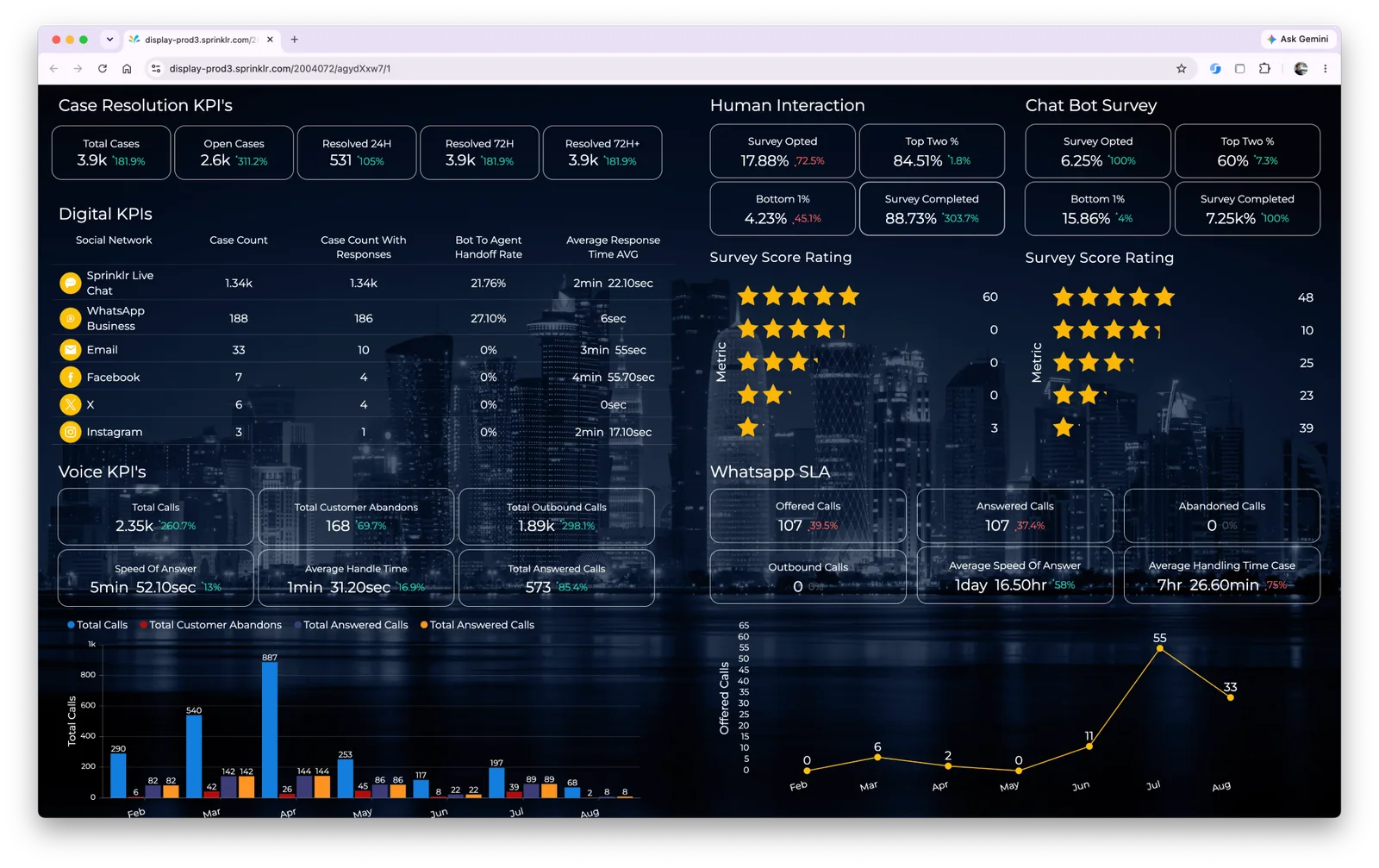
Holding the quality bar
I led critiques and production reviews across customer implementations, looking at visual quality, interaction design, accessibility, consistency and technical feasibility.
To make good work repeatable, the team built shared starting structures for contact-center displays. Designers began from a proven pattern and adapted the hierarchy to each customer’s data, priorities and brand.
- Metric overviewHigh-level performance at a glance.
- Trend and comparisonPerformance over time, with key metrics side by side.
- Sentiment summaryCustomer sentiment and related feedback.
- Queue performanceQueue volume, wait time or service level compared.
Staying close to the work
I stayed hands-on so my direction came from current knowledge of the product and its customers.
- Ran about six pre-sales platform demonstrations a year.
- Led quarterly internal refresher training on the product.
- Took on client work myself when project volume exceeded the team’s capacity.
- Acted as a product-domain resource for the new Product Analyst, turning customer insights into workflow guidance and enhancement priorities.
- Worked with Engineering on navigation and drill-down features that improved customer implementations.
I also protected the team’s focus. Other product teams needed branded sites for Sprinklr Advocacy and Community, and I built most of those myself so my designers could stay on Display. See that work.
Making the case for the product
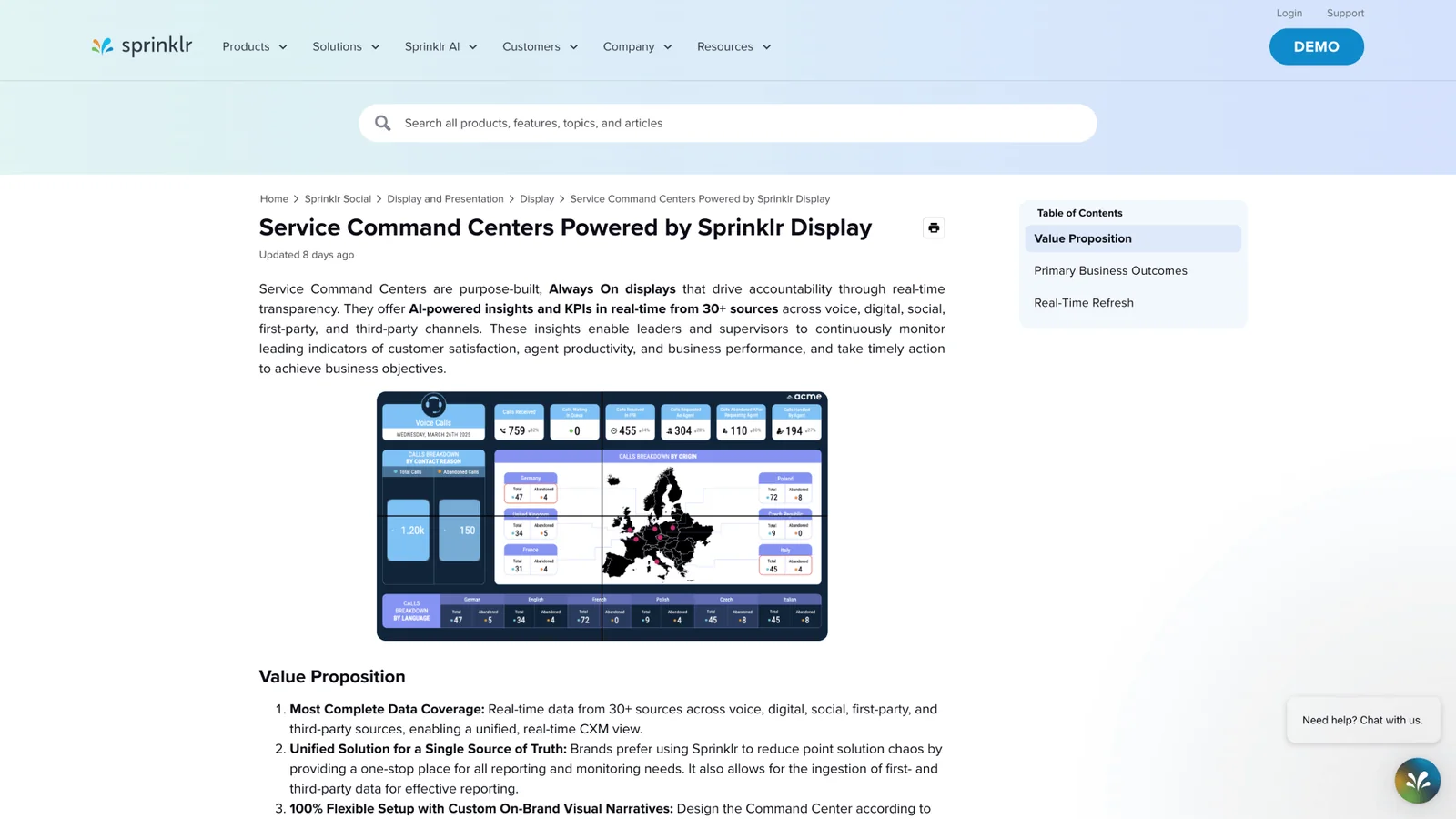
In 2022 Sprinklr Display was in maintenance mode. During an executive leadership transition I set out to show leaders and the wider company what the product could do.
- A deck and a live demoI built a deck and demonstrated the product to the C-suite.
- Global trainingI hosted product training for the whole company.
- Displays in our own officesWith the team, I built internal Displays shown on office screens in New York, Austin, London, Dubai, Brazil and Japan.
The work helped bring sales attention back to the product. Development resumed, and Display moved to updates and a relaunch in 2025. The story of the product itself is in the Sprinklr Display case study.
Outcomes
- 30% more projects completed each month, comparing the design team’s average monthly completions before and after the process changes.
- Two junior hires advanced to Senior Designer.
- A product back on the roadmap: from maintenance mode in 2022 to a relaunch in 2025.
- A five-day design window in the Statement of Work for every project.
- Customer guides in Sprinklr’s Knowledge Base that outlast each handoff.
What I learned
- Fix the inputs before asking for speed. Most of the delay came from starting with incomplete data, so that is where the time was won.
- A rule starts as a habit someone defends. The five-day window was friction on calls before it was a line in the Statement of Work.
- Junior designers need permission to say no. Teaching them to set expectations politely protected their time and the work.